By: Jean Won
Edited by: Professor Jan Lin
First off, thank you to Mr. Burt Freighly up in Washington state for the generous funding for publication of this work.
Many thanks to Mr. John Miller, president of the Historical Society, for the wealth of knowledge of Eagle Rock history and faith that I wouldn’t swipe any of the materials in the archive. (rest assured)
Thanks to everybody who took the time to have an interview with me over the years, including Henry Welcome, Doris Thielan, Kaye Beckham, Linda Allen, Ruby DeVera, Reverent Norman Gordon, Eric Warren, Nick Pacheco, Kathleen Aberman, Jack Tritch, Merrit Tritch, Officer Joe Valindo, Richard Alatorre, Angela Robinson, and Bob Thielan. Although I was not able to include quotes from every one of you, you have all significantly contributed to the development of this paper.
I would like to acknowledge the Occidental College Summer Research Program and the Ford/Anderson/Camp Fellowship for the funding of the research in this work.
Thank you to Professors Jan Lin and Warren Montag from Occidental College for all their guidance, support, and especially their food. Professor Lin, thanks for all the time you took out of your busy schedule for this.
And finally, thanks to my mom, Ann Choi, for her support, love, and friendship.
Author Biography
Jean Won is an Eagle Rock native and graduate of
Eagle Rock High School. She is currently a student of Sociology at
Occidental College.
| Table of Contents |
| Introduction |
| Native American Era |
| Spanish/Mexican Era |
| Farming |
| As a Small Suburb |
| Part of Los Angeles |
| “The City,” Place Memory, and Eagle Rock |
| The Eagle Rock |
| The Rock Threatened |
| The Struggle at Townsend |
| A Different Battle |
| New Community Efforts |
| Turning Old Buildings into New Ideas |
| New Issues |
| Works Cited |
| Persons Cited |
| Acknowledgements |
|
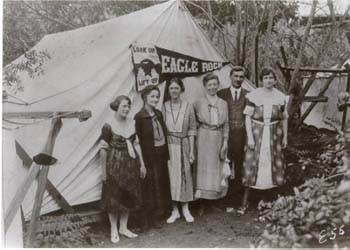
*Back cover photo of the Eagle Rock courtesy, John Miller, president of the Eagle Rock Valley Historical Society |
Eagle Rock is a small neighborhood in northeastern Los Angeles, California. Although humble in appearances, this place serves as a significant sociological laboratory because the residents of Eagle Rock have always held great pride in their neighborhood. An examination of this pride will take place using the sociological concept of “place memory,” a topic discussed later in this work. However, in order to truly understand the character of Eagle Rock today, an exploration of Eagle Rock history must first take place. Historians such as Betty Welcome have traditionally broken the history of Eagle Rock into five periods: these periods include: (1) a Native American era, (2) a Spanish/Mexican and Anglo Pastoral age, (3) a small farming era, (4) a period of Eagle Rock being a suburban portion of a tiny municipality, and finally (5) an era of being a small suburb of the larger city of Los Angeles.
Information about this era is scarce – however, the original Native American tribe in the Eagle Rock area is believed to belong to the Shoshone language group (Figure 1). The Shoshone Native American tribe is now referred to as the Gabrieleno tribe because of their affiliation with the San Gabriel Mission. There has been evidence of the Gabrieleno settlement found near the present day sites of Eagle Rock High School, Glendale Adventist Hospital, and the Arroyo Seco. A nomadic people, the Gabrieleno tribe used animals, berries, seeds, roots, and acorns as a primary source of subsistence. Their homes were made of wooden sticks called willow wands made permanent by reinforcing them with mud (Figure 2).
This era is said to have started with Father Francisco Garces, a priest at the San Gabriel Mission, who passed through the Eagle Rock Valley in April of 1776. Three years later in 1779, José María de Verdugo and his wife, María de la Encarnación López, got married at the San Gabriel Mission. Verdugo was a soldier of the King of Spain and the Corporal of the Guard, who
Figure 1 – The Gabrieleno people, who are
believed to have settled in Los Angeles, including Eagle Rock.
Courtesy: Eagle Rock Valley Historical
Society Archives, photo donated by the Southwest Museum to the historical
society.
Figure 2 – An early Gabrieleno home made of
willow wands
Courtesy, Eagle Rock Valley Historical Society,
picture donated by the Southwest Museum
decided to supplement his income by grazing cattle. Verdugo petitioned for land rights from Governor Pedro Fages, and in 1784, was given a huge amount of land bounded by the areas of Devil’s Gate, the Arroyo Seco, the Los Angeles River, Elysian Park, Sun Valley, La Crescenta and Griffith Park. Verdugo’s brother, Marino, was appointed to plant crops on the land, and soon the rancho included the present day areas of Eagle Rock, Glendale, Burbank, Mt. Washington, Flintridge, Montrose, Highland Park, as well as portions of Pasadena, La Crescenta and La Cañada. However, Julio, José Verdugo’s son, took a mortgage that he was unable to pay due to high interest rates, leading to the loss of all of his property except for 200 acres. The rest of Julio’s land was divided among 28 people. The Verdugos are remembered by areas surrounding Eagle Rock – Glendale, for example, holds an annual parade to commemorate the Verdugos. Dora Verdugo (Figure 3), great-granddaughter of José Maria Verdugo, has been recognized in various community events in memory of LA’s Spanish/Mexican past.
Figure 3 - Dora Verdugo in 1967
Courtesy, Eagle Rock Valley Historical Society
Clip Files, from Glendale Star, 9/7/67.
An anecdotal flood is said to have filled the Eagle Rock valley to the brim in 1884: this flood is credited with making the valley’s soil incredibly fertile, beginning the third era of small farms. Pictures of the Eagle Rock valley around the year 1900 indicate the rural nature of the region (Figure 4). Eagle Rock’s J.J. Broomall Dahlia Farm was world renowned for its hybrid dahlias, which were shipped to various countries. J.J. Broomall, the owner of the Dahlia farm, was said to be a “genius at grafting, cross-pollination, and creating hybrid dahlia bulbs” (Harsh 1). Another famous farm, the Gates Strawberry Ranch, covered Eagle Rock from Eagle Rock Boulevard to Maywood Avenue, from Yosemite Drive to Colorado Boulevard. The Gates Strawberry Ranch hired Chinese laborers who trained to become officers for the Chinese Revolutionary Army on weekends from 1903 – 1909. These men were trained by Sgt. Ansel O’Banion, under the command of Lt. General Homer Lee. Lee was a military genius with an
Figure 4 – The Eagle Rock Valley in about
1900
Courtesy, Eagle Rock Valley Historical Society
education from Occidental College and Stanford University. According to Eagle Rock: Then and Now, “what is interesting is that O’Banion with his blue uniformed Chinese would often ride the big red street cars of the Pacific Electric to Highland Park and then hike up what is now Figueroa street to the hills of Eagle Rock for some of their field training (Smith & Friezer 4).” These soldiers contributed to the creation of the Chinese republic in 1911, resulting in Dr. Sun Yat Sen as China’s first president.
The fourth era of being a small suburb of a tiny municipality begins sometime near 1909. This era is commonly represented by streetcars (Figures 5 and 6), because during this time, Los Angeles had the best and most expansive public transportation system in the United States. Miller commented that “these Red Cars were fantastic – The #5 car took us from Eagle Rock straight to the ocean.” Jack Tritch, a long time resident and business owner in Eagle Rock commented on streetcars saying, “We loved them. They got us around pretty easy and were fun.”
Figure
5 – Early Eagle Rock streetcar and passengers, approximately 1910
Courtesy, Eagle Rock Valley Historical Society
Archive
Figure 6 – Eagle Rock streetcar traveling south
on Eagle Rock Blvd. in the 1940s, just prior to their removal
Courtesy, Eagle Rock Valley Historical Society
Archive, photo donated by Alan Weeks
Nicknamed “the galloping goose” and “the dinky,” the streetcars were efficient and popular - that is, until the automobile put them out of commission. According to a October 24, 1909 edition of the Los Angeles Herald Sunday Magazine,
The pretty little suburb of Eagle Rock is only three years old. It was awakened into life by the magic wand of Huntington’s Trolley System in August 1906. Those who knew Eagle Rock at that time will recall it was a picturesque bit of country scenery, tucked away by itself, far from the main roads of travel. Although as the crow flies but six miles from Los Angeles, it might just as well have been a hundred miles distance as far as its availability for suburban life was concerned. (Welcome 3)
It was during this era that the first concrete roads were beginning to take shape. Colorado Boulevard was paved at this time, along with Hill Drive, amongst others. Eagle Rock continued to be isolated even after the trolley system was placed because “Eagle Rock has always been a sleepy, backdoor community. The reason people have always settled in Eagle Rock is to get away from the hustle & bustle of LA” (Miller, 12/6/98). Eagle Rock was its own city for approximately 2 years. However, like many other towns, Eagle Rock became a part of Los Angeles due to the threat of water shortage in the 1920’s.
In 1923, the fifth portion of Eagle Rock history was started with the neighborhood becoming a part of the city of Los Angeles. According to John Miller, historian and president of the Eagle Rock Valley Historical Society, Eagle Rock became a part of Los Angeles because of the need for adequate water, schools, and sewers. After incorporation into Los Angeles, Eagle Rock High School was opened in 1927 with 690 students. Sewers were put in, and ironically enough, Sparkletts Drinking Water Corporation was founded right on York Boulevard 2 years after annexation in 1925 (Figure 7). Still the headquarters for the company, the three wells the corporation was built on are located right underneath York Boulevard. Now Sparkletts is one of most prosperous water bottling companies in the world.
Figure 7 – Sparkletts Water Company soon after
its founding
Courtesy, Eagle Rock Valley Historical Society
Archives
This era, of Eagle Rock being part of the city of Los Angeles, is now the focus of this paper, for Eagle Rock history does not end with streetcars and old buildings. History is rather a continuous chain of events that dramatically shape the character of a place. The following is an examination of a small part of Eagle Rock in recent years through a sociological perspective.
“The City,” Place Memory, and Eagle Rock
The city as a whole, is inaccessible to the
imagination unless it can be reduced and simplified. Is it surprising,
therefore, that people will literally step back and away form the city to gain
perspective on it? Distance clears the field of vision, even if it means
losing some of the rich detail (Wohl & Strauss 524).
In their work entitled Symbolic Representation and the Urban Milieu, Wohl
& Strauss elaborate upon the idea that the city is too complex for a person
to comprehend in its entirety. As a result, cities are often represented
by a chosen number of sites within the city, as depicted by material
representations of cities such as maps (Figure 8). For example, the Statue
of Liberty can immediately associate itself with New York City. The Statue
of Liberty also signifies freedom, or a refuge for immigrants from all parts of
the world. In much the same manner, Eagle Rock, a small community located
just six miles northeast of Downtown Los Angeles, can be understood and
represented by several sites. Such sites would include the Eagle Rock
(Figure 9), the Eagle Rock City Hall (Figure 10), the Eagle Rock Community
Cultural Center (Figure 11), or the Women’s Twentieth Century Club (Figure
12), all of which have been designated as Historical Landmarks by the Los
Angeles Cultural Heritage Commission.
Often, representative sites have a
strong sense of place memory attached to them. “Place memory” as
studied by sociologists, is a concept in which sites may be used to stimulate
social memory. To members of a community, a select number of sites serve
as “storage spaces” of accumulated positive or negative experiences in a
larger urban area. “It is the key to the power of historical places to
help citizens define their public pasts; places trigger memories for
insiders, who have shared a common past, and at the same time places often can
represent shared pasts to outsiders who might be interested in knowing about
them in the present” (Hayden 46). When the sites are threatened,
even a usually disjunctive community can become intensively cohesive in order to
save the significant sites. A strong sense of community consensus is
uncommon in an urban area due to the impersonal and heterogeneous nature of
urban spaces. Determinist social
Figure 8 - Early map of the town of Eagle Rock
Courtesy, Eagle Rock Valley Historical Society Archives
Figure 9 – The Eagle Rock, Los Angeles Historic Cultural Monument #10,
declared 11/16/62
Courtesy, Eagle Rock Valley Historical Society Archives
Figure 10– The Eagle Rock City Hall, Los Angeles Historic Cultural Monument
#59, Declared 2/26/69
Photo taken by author, 7/15/99.
Figure 11 – The Eagle Rock Community Cultural Center, formerly the Eagle
Rock Branch Library. Los Angeles Historic Cultural Monument #292, Declared
6/18/85
Photo taken by author, 7/15/99.
Figure 12 – The Eagle Rock Women’s Twentieth Century Clubhouse, Los
Angeles Historic Cultural Monument # 537, Declared 7/2/91
Photo taken by author, 7/15/99.
theorists believe that the intensification of nervous stimulation, that is, an excess of sights and sounds in the city, causes
people to become apathetic and disinterested. In turn, apathetic people compose an impersonal atmosphere in an urban place,
which leads to a state of anomie, or normlessness. If anomie lasts for an
extended period of time, a segmented city results. Determinist social
theorists such as Georg Simmel assert that,
At the community level, people differ so much from each other in such things as their jobs, their neighborhoods, and their life-styles that moral consensus becomes difficult. With divergent interests, styles and views of life, groups in the city cannot agree on values or beliefs, on ends or on means. As community-wide cohesion is weakened, so is the cohesion of the small, intimate, “primary” groups of society, such as family, friends and neighbors – the ones on which social order and individual balance depend on. Thus, by dividing the community and by weakening its primary groups, differentiation produces a general loosening of social ties (Fischer 63).
Although Simmel’s analysis of urban social life is applicable to various urban areas, the threatening of community sites by urbanization and economic development has often fostered urbanites’ ability to form new unified groups in order to work for a common cause. Two sites in which this has happened in recent years include the Eagle Rock and the building at the intersection of Townsend and Colorado Boulevards.
Perhaps the most commonly used site to represent the community of Eagle Rock, a large sedimentary rock with the imprint of an eagle in flight known as The Eagle Rock has been threatened twice. The Rock is the landmark that the community of Eagle Rock was named after. Formerly known as La Piedra Gorda (translating to “Fat Rock” in Spanish), the Eagle Rock served as an important landmark and an early tourist attraction in Los Angeles. Named as “the most distinctive natural landmark in the City of Los Angeles” by Carl Dentzel, former Director of the Southwest museum, the Eagle Rock was also home to the first sunrise Easter service in California in 1917. The Eagle Rock has served as the emblem of the old community newspaper, The Eagle Rock Sentinel, as well as been used in the slogan of, “Eagle Rock: The community founded upon the Rock.” According to a Los Angeles Times article, Shirley Minser, a 40 year citizen of the community, said “The Eagle Rock to this community is like Mt. Rushmore is to South Dakota” (Goldman 1). The Eagle Rock originally was used by Native Americans who inhabited the area as a type of fort because it was a good location to see movements of settlers in the area. The bandit Tiburcio Vásquez was said to have used the rock as a hideout before he robbed people in 1874. An alcoholic French beekeeper also used to live in one of the 2 caves in the rock. Jim Beckham, who was a former president of the Chamber of Commerce for Eagle Rock, said, “I think that’s my favorite story. There was really someone living there” (Goldman 2).
Although the Eagle Rock has
historically been embraced by the town as its emblem, the Rock did not actually
belong to the community until 1995 when the city of Los Angeles officially
purchased the Rock for close to $700,000. Appraised at $250,000 in
1962 by James Real, the Rock was named a cultural monument in November of 1962.
With this status, “the owner of the monument was forbidden to demolish, alter,
or remove it unless it constitutes a public health hazard” (Los Angeles
Times 1962). Real instead placed apartments along the east side of the
Rock (Figure 13). Although citizens protested, the community was unable to
stop Real’s apartment developments. 1962 was a period in which Eagle
Rock residents did not yet have the organizational ability to effectively fight
against such development.
When the
Rock was again threatened with development in 1988 by owner Fred Heim, the
people of Eagle Rock took action. A “Save our Eagle Rock” campaign was
headed by Katie Smith, resulting in rallies to raise money in order to purchase
the rock from Heim. A large pancake breakfast was held in the parking lot
of the Eagle Rock Plaza on November 5, 1988, with Mayor Tom Bradley, Councilman
Richard Alatorre, and an excess of 3,000 people supporting the event (Figure
14). Several thousand dollars were donated by community organizations.
The large turnout at the event, as well as the amount of money raised and
donated by the community
Figure 13 – Residential development in back of the Eagle Rock
Photo taken by author, 7/15/99.
Figure 14 – Former Councilman Alatorre and Mayor Tom Bradley helping to
serve pancakes at the “Save our Eagle Rock” fundraiser pancake breakfast,
11/5/88.
Courtesy: Eagle Rock Valley Historical Society Archives, taken from The
Eagle Rock Sentinel
displays an intensive amount of cohesion within the community. However, perhaps even more incredible is the fact that the city of Los Angeles paid so much in order to purchase the Rock. The Eagle Rock, after years of struggle, is now a publicly-owned landmark.
A second site in which residents of Eagle Rock have taken an active role in
preservation were a series of pre-WWII brick storefront buildings located at the
intersection of Colorado and Townsend Boulevards (Figure 15 and 16).
Popularly known as one of the three traditional downtowns of Eagle Rock (the
other two being located at the intersection of Eagle Rock & Colorado and the
other at Townsend & Yosemite [referred to as “happyland”]), the brick
storefronts were threatened with demolition in 1986 by a developer, intent on
building a new mini-mall. Upon hearing about this, an Eagle Rock resident
named Kathleen Aberman decided to take action. “Those buildings were the
best looking half-block area on Colorado Blvd, Eagle Rock’s main street.
When I found out that another parking lot was going to face the sidewalk instead
of the wonderful storefronts, I was disappointed” (Aberman 7/14/99).
However, when Aberman tried to get historical status for the structure at the LA Cultural
Heritage Commission, the developer’s lawyer deceived Aberman, promising her
that the storefronts would be preserved. Instead, bulldozers arrived at 5
a.m. the following morning, before the community could protest (Figure
17). Although Aberman tried to talk the constructors out of bulldozing the
building from the rooftop, she was instead arrested by police and the building
was torn down (Figure 18).
A story
significant enough to make the front cover of the local news section of the Los
Angeles Times on November 9, 1990, Aberman’s stand atop the roof of the
building is an example of how intensely people associate sites with the larger
city. Not only was the building attractive, but it was also a site to
which citizens attached strong memories and rituals to. Although the
attempts to save the building were unsuccessful, the community became more
organized after the fact. The demolition of the Townsend/Colorado
buildings led to the founding
Figure 15 – The corner of Colorado and Townsend Boulevards, approximately
1942.
Courtesy: Eagle Rock Valley Historical Society Archives, photo taken
by: Alan Weeks
Figure 16 – Close-up of stores on the intersection of Townsend and Colorado
Blvds.
Courtesy: Eagle Rock Valley Historical Society Archives, taken from The
Los Angeles Times, 11/9/90
Figure 17 – Demolition of the corner of
Townsend/Colorado
Courtesy: Eagle Rock Valley Historical
Society, taken from The Eagle Rock Sentinel, 3/4/87
Figure 18 – Kathleen Aberman being arrested from
atop of the roof of the Townsend/Colorado buildings.
Courtesy: Eagle Rock Valley Historical
Society, taken from a Los Angeles Times article, 11/9/90
of TERA (an acronym for The Eagle Rock Association) and the Colorado Boulevard Specific Plan. TERA, a group comprised mainly of homeowners, now contributes its input into various urban development and community issues. The Colorado Boulevard Specific Plan is now official law due to its approval by the Los Angeles City Council. The Specific Plan regulates development along Colorado Boulevard, forbidding the building of new structures such as mini-malls, motels, and auto-related businesses. The Townsend/Colorado building is significant for the community struggle involved to preserve the building as well as for the various organized outcomes of the demolition.
The power struggle involved at this site was the
resulting battle between historical preservation and economic development.
The installation of the mini-mall is a display of the unregulated economic
interests on the boulevard common throughout the 1980’s (Figure 19). In
the 1980’s any type of business was seen as “good business” without regard
to its effects on Eagle Rock’s pedestrian environment or overall appearance on
the boulevards. TERA now seeks to regulate what types of businesses can be
allowed to enter or expand on Colorado. Sadly enough, despite the rush of redevelopment attempts along the boulevard
throughout the 80’s, Colorado Blvd. continues to look economically depressed.
However,
the formation of TERA does not necessarily indicate a state of stability or
equilibrium in the community of Eagle Rock. TERA stands for the causes of
historical preservation, community beautification, and zoning and planning
issues. However, to counter their interests, the Eagle Rock Chamber of
Commerce, a merchant's group interested in economic development, continues to
push for economic interests. The feuding of these two groups has been
long-standing and intense. It has been said that, "They used to fight
about everything. Once, ladies from each group started fighting because a
lady from one group did not get their hair dressed in Eagle Rock"
(Miller 7/15/99). Another Eagle Rock citizen stated that "The two
groups are essentially different in basic philosophies" (Warren
5/27/99). The battle between
Figure 19 – The corner of Townsend and Colorado
Boulevards in modern days, with the installation of a mini-mall.
Photo taken by author, 7/15/99.
economic interest and historical preservation raging, the feud led by these two groups often prevented coordinated planning from being carried out in the community.
In order to stop the feuding and lead the community
with a unified action group, the ERCPR, an acronym for the Eagle Rock Community
Preservation and Revitalization Corporation (formerly known as the Eagle Rock
Revitalization Coalition), has been formed. ER CPR is a representative
group of various interests throughout the community, including TERA, the
Historical Society, the Chamber of Commerce, business owners, and members from
Occidental College. The two feuding interests in the community, historical
preservation and economic development, have been acknowledged in the ER CPR
through the formation of its two task groups, business enhancement and image
enhancement. The image enhancement committee is primarily concerned with
the up-keeping of the two main commercial Boulevards in Eagle Rock (Colorado and
Eagle Rock Boulevards), looking into ways to keep the boulevards attractive.
The business enhancement committee is concerned with improving the condition of
businesses on the boulevards so that the vacancy rates in the commercial parts
of Eagle Rock will stay down. In a November 1998 Chamber of
Commerce Newsletter, it was said that a few years ago, 50% of Eagle Rock’s business district was vacant. “The problem,” Jack
Tritch, a community businessman commented, is that Eagle Rock has “too many
empty stores” (12/2/98).
Among others, the Coalition’s
plans are to attract “mom & pop” business that have been displaced due
to revitalization efforts in Old Town Pasadena, Glendale, and South Pasadena
while enhancing the appearance, safety, and parking capacity of Eagle Rock.
Ed, a member of the business enhancement committee, brought a bit of humor to a
meeting saying “I think we should put a huge statue right in the middle of the
intersection of Eagle Rock & Colorado Boulevard that looks like the Statue
of Liberty. It should say ‘Give me all your tired, displaced “mom
& pop” business from Pasadena, Los Feliz, and Glendale’” (12/7/98).
Turning Old Buildings into New Ideas
However, the debate between
economic development and historical preservation can no longer be seen as purely antagonistic.
Rather, the two now support each other. As proven by the experience of
such as Old Town Pasadena, old buildings and storefronts can now be used to
create unique and attractive shopping environments. Capitalists have
learned that popular shopping places can be advanced through the preservation of
old historic buildings. ER CPR is also planning on using this idea to
revitalize Eagle Rock businesses. Architectural prototypes have been drawn
for the southeastern corner of Eagle Rock & Colorado Boulevard as an
example. Formerly known as the Edwards and Wildey
Building (Figure 20), this general area is now commonly referred to as the Duffy
Building. This area is considered "the center of Eagle Rock.
It’s really the focus of everything. The Duffy Building is one of the oldest
buildings in the city. It was a considerably nicer looking building than it is
now, but we all feel the building is restorable (Figure 21)" (Warren
5/27/99). By using the pre-WWII building’s architectural
uniqueness, ER
Figure 20 – Old newspaper clipping of Edwards and Wildey Building being
built on the southeastern corner of Eagle Rock and Colorado Boulevards.
Newspaper clipping courtesy of Eagle Rock Valley Historical Society Archive,
name of newspaper and date unknown.
Figure 21– The southeast corner of Colorado and Eagle Rock today, proposed
site for Eagle Rock revitalization
Photo taken by author, 7/15/99.
CPR is hoping to restore the building and give Eagle Rock a shopping area with a “hometown” feeling. The architectural prototypes include a sign that states “Eagle Rock: LA’s Hometown (Figure 22).” However, the Duffy Building itself is not without its problems. Small lot size and the absence of parking have made it difficult for a keystone developer to come into the area. Also, the new parking lot located at the posterior of the building belongs to the city of Los Angeles, and each parking spot, if purchased from the city, currently has a price tag close to $17,000. With the opportunity to rent the parking spot if a developer became interested, the Duffy building remains unaffected due to the absence of an interested developer. An additional obstacle is the current vacant lot in the Duffy Building, formerly the site of Jerry's Television Repair Store (Figures 23 and 24). The old site of Jerry’s is essential to the possibility of the architectural renderings of the Duffy building to become reality because the ER CPR would like that space to be torn down in order for pedestrian traffic to become circular throughout the building (Figure 25). Eric Warren commented that,
Jerry’s got sold at auction for about 10 thousand dollars, and the guy that owns it now wants about 150 thousand for it. The city was auctioning it off, and some people pay attention, some don’t. We should have been paying attention, but it was before efforts were really organized, I mean, the coalition has only really happened in the last couple of years. Before that, there were various revitalization efforts, but there was conflict in the community then too (5/27/99).
Referring to the conflict between the Chamber of Commerce and TERA, Eagle Rock now has the hope of the ER CPR to lead the community towards a healthy balance of both historical preservation and economic interests. Although the complete revitalization of Eagle Rock can take well up to 10 years, Tom Topping, chairman of the Coalition, stated that, “We’re going to do more than just talk” (12/7/98). Exactly what to do now, however, is still in a state of limbo. The coalition must decide on exactly what types of businesses would flourish in Eagle Rock. The debate between large chain stores such as Blockbuster’s and Rite Aide and small ‘mom and pop” stores is still hotly debated.
Figure 22 – Prototypes for the revitalization of the Duffy building by the
ERCPR
Courtesy: ERCPR
Figure 23 – Former site of Jerry’s Television Repair store viewed from
Colorado Blvd.
Photo taken by author, 7/15/99.
Figure 24 – Back of Jerry’s Television store site in the Duffy building
Photo taken by author, 7/15/99.
Figure 25 – Prototypes of the back of the Duffy Building, showing how the
site of Jerry’s will be eliminated in order to accommodate circular pedestrian
traffic
Prototype courtesy of ERCPR
However, now that the relationship between economic development and
historical preservation have become more positive, a new conflict arises –
race and multiculturalism as a barrier to creating community. While some
embrace the new multiculturalism of Eagle Rock, others feel threatened by the
recent influx of minorities. Even 25 years ago, “Eagle Rock had
the reputation of being an almost entirely white, very conservative area,
populated by many families of policemen and firemen seeking an easy commute to
work and a refuge from inner-city troubles” (Gordon 2).
According to 1990 census information gathered in zip code 90041, Eagle Rock was
home to 26, 864 people, with 31.2% classified as White, 32.3% classified as
Hispanic, 19.2% classified as Asian, 1.8% as Black, and 0.3% as Native American.
Henry Welcome, long time historian and founding president of the Eagle Rock
Valley Historical Society, stated that, "I came to Eagle Rock in 1927 when
I was 11, and we had almost entirely what’s known as WASPs. Now it’s
gone the other way, the place is changing all the time" (6/16/99).
While the politically-correct generation of today may state that race is
unimportant in forming community, others are subtly bitter about the increasing
diversity. According to a Caucasian woman who has been a resident of Eagle
Rock for 68 years, “I think the neighborhood’s gone downhill. It used
to be a big family, but not anymore. Now there's a lot of break-ins and
graffiti” (5/27/99). Going back to social theorist Georg Simmel,
the heterogeneity of urban places is a contributing factor in the increasingly
impersonal and detached nature of social groups and residential communities.
Race and ethnicity, therefore, are essential in understanding places and
communities. Dolores Hayden's The Power of Place, states that,
“Ethnicity, as well as race, class, and gender, can be uncovered as a shaping
force of American urban places, provided one looks at the production of social
space carefully” (Hayden 34). Race and ethnicity are
powerful forces in analyzing urban places. The effects of such factors are
subjects for further research.
Through the exploration of public history of publicly contested sites in Eagle
Rock, we are better able to understand Eagle Rock’s community and its
struggles between preservation and economic development. “Place
memory” and the notion that certain sites serve as “containers” of
memories of the area serves to further strengthen the relationship between the
two. Although the hope is that such spaces will not be threatened in
future years, the contestation of such spaces have brought the community to
unite for the common good of the entire neighborhood. Our hope is that the
ER Community Preservation and Revitalization group can lead us in the right
direction.
Fischer, Claude S. “Theories of
Urbanism.” From Gmelch, George & Walter Zenner.
Urban Life, St. Martin’s Press, New
York: 1980.
Goldman, Abigail. “Cityscapes/ Abigail Goldman: For Old Timers,
Any Price is a Bargain for the Eagle Rock.” The Los
Angeles
Times, Home Edition. From http://web.lexis-nexis.com.
September 9, 1995.
Gordon, Barry. “Eagle Rock to Celebrate its Close-Knit Identity.”
The Los Angeles Times, Home Edition. From
http://web.lexis-nexis.com.
September 19, 1985.
Harsh, J. Richard. Diary of Richard Harsh, neighbor of J.J. Broomall.
Hayden, Dolores. The Power of Place : Urban Landscapes As Public History. MIT Press, Boston: 1995.
Smith, K. and Friezer, J. Eagle Rock: Then and Now. Lucky Printing Co. Los Angeles: 1987.
U.S. Census Bureau: The Official Statistics. From http://www.census.gov. Download date: December 1, 1998.
Welcome, Betty. The History of Eagle Rock. Eagle Rock Valley Historical Society. Eagle Rock.
Wohl, R. Richard and Strauss, Anslem.
“Symbolic Representation and the Urban Milieu.” American Journal of
Sociology,
Volume 63 (March), pages 523-532.
Aberman, Kathleen. Founder of The Eagle Rock Association (TERA)
Ed, member of ERCPR
Miller, John. President of the Eagle Rock Valley Historical Society.
Topping, Tom. Chairman, Eagle Rock Community Preservation and Revitalization Corporation.
Tritch, Jack. Tritch Hardware
Warren, Eric. Architectural expert and resident of Eagle Rock.
Welcome, Henry. Founding president of the Eagle Rock Valley Historical
Society